 Wend
Why a bike app
A bike is not a small car
Most cycling directions come from apps made for drivers, with a bicycle mode added. Wend starts from what is true on a bike.
| On a bike | A car app assumes | Wend |
|---|---|---|
| You get a one-second glance | Time to read text and lane diagrams | One arrow, one distance, one street. Or just the voice. |
| The view is half the ride | A flat map you have to decode | The real city in 3D. Spot the landmark, then look up again. |
| The phone shakes, in sun and rain | A steady screen in a shaded cabin | Large type on a halo, gestures that work anywhere |
| Any path or cut-through is open | Leaving the route is an error | Leaving the route is a choice. It plans on from there. |
| Walking pace uphill, 40 km/h down | Cues at fixed distances | Cues timed in seconds, earlier when you are faster |
| Moving and stopped are different moments | One layout, whatever you are doing | Less at speed, more at a standstill, and it follows a detour |
| You are out in the weather | Weather is a comfort setting | Rain and wind warnings before they reach you |
In practice
What that looks like
The screen changes with what you are doing. Pick a moment.
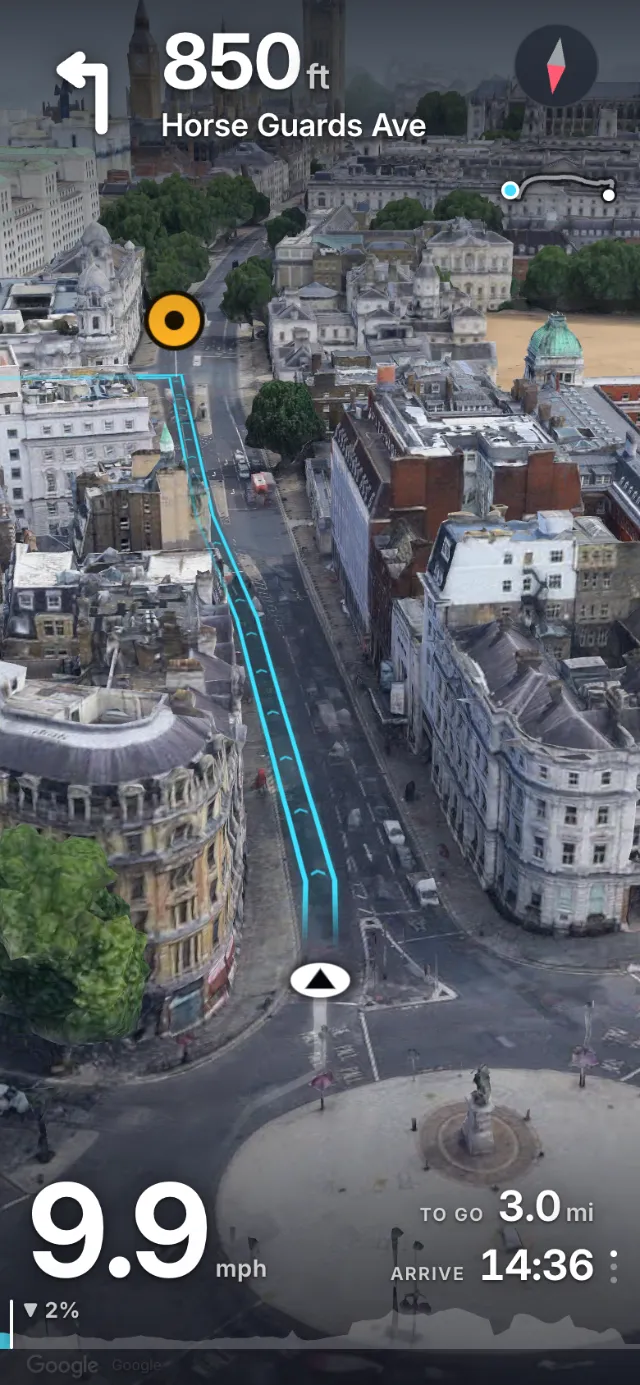
On the move it keeps to the edges: the turn, your speed, how far and when.
- Next turnWhich way, how far, onto what
- View3D ride view or flat map
- Whole routeWhere you are along it
- Turn markerThe junction, pinned in the scene
- RouteDrawn on the road itself
- YouFacing the way you ride
- SpeedThe one number that stays
- To go and arrivalAt the pace you really ride
- GradientThe climb ahead, and the profile
Design principles
Eight rules every feature has to pass
- The ride comes firstThe map and the road ahead are the interface
- Every pixel earns its placeShown only while it is useful
- Readable in a glanceOne idea per element, large numerals, few words
- Never in the wayInformation lives at the edges of the map
- Everything can be put awayOne gesture, and the app remembers
- Listen through every channelSpeed, direction and habit, before asking
- Follow the rider’s leadA companion, not an instructor
- Speak in more than pixelsVoice and a buzz, so you need not look